God’s Kingdom Together
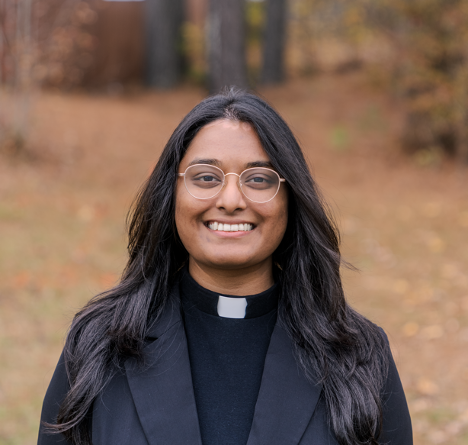
Sermon by Pr. Sharai Jacob on the Third Sunday After Epiphany + Saturday, January 24, 2026
Our reading today shows us Jesus beginning his public ministry. In the chapter before, John the Baptist baptizes Jesus, and at the start of our reading today, John has been arrested. The prophet who spoke truth to power, who spoke on behalf of the poor and oppressed, has been silenced. This is a moment when fear is real, when the cost of faithfulness is made clear. And then Jesus moves. Literally physically moves.
Not to Jerusalem. Not to the center of religious or political power. Not to a place of great respect or influence.
But to Galilee.
Matthew is very clear: this move is not accidental. Matthew points back to Isaiah to help us see what’s really happening. “The people who sat in darkness have seen a great light.”
Galilee was a borderland, “Galilee of the Gentiles.” It was a mixed place. Politically vulnerable. Overlooked and often looked down on. If you wanted power or credibility, Galilee was not the place to start.
And yet—this is where the light appears. Which tells us something important about God. God does not begin with the powerful or the polished. God’s light shows up on the margins—among people who are tired, burdened, and used to being told that they don’t belong.
Jesus begins preaching with a simple, urgent message: “Repent, for the kingdom of heaven has come near.”
For Matthew, “the kingdom of heaven” doesn’t mean escaping this world someday. It means God’s reign, God’s presence, in this world right now.
The phrase comes from Israel’s deepest hopes: justice instead of exploitation, mercy instead of violence, faithfulness instead of corruption. And because of that, this message is not only spiritual. It is political – political in the sense that it challenges every system that claims absolute power over people’s lives.
And that “ kingdom of heaven” that challenge, that hope “has come near.” Not “will arrive eventually.” Not “exists somewhere else.” God’s reign is close enough to touch. Close enough to make waves in the world. Close enough to demand a response.
That’s a message that can be both hopeful and unsettling.
Hopeful—because it means injustice does not get the final word. Because the suffering we see around us is not invisible to God. Because another way of living together is actually possible in our world.
But unsettling—because if God’s reign is near, then the empires and systems of this world, which offer us safety and stability, are being threatened. Because those empires and systems run on dehumanization, exploitation, and fear.
When we look around today, it’s not hard to see a need for God’s Kingdom. Families separated. People detained and disappeared. Entire populations treated as disposable. Violence carried out in the name of security or profit or simple hate.
The longing for God’s reign isn’t abstract. It rises from very real pain. The people of Galilee had lost John. They were oppressed, powerless, and probably losing hope. Jesus does not respond to that pain with distance or neutrality. He responds by drawing near.
Matthew gives us a snapshot of what that nearness looks like in verse 23:
“Jesus went throughout Galilee, teaching… proclaiming the good news of the kingdom… and curing every disease and sickness.”
Teaching. Proclaiming. Healing.
Not only words, but also action. And notice that Jesus participates in God’s Kingdom in more than just one way. And that’s true for all of us: Some teach. Some proclaim. Some heal. Some organize. Some listen. Some feed. Some show up quietly and faithfully day after day.
Look at how the disciples are called! Jesus sees Simon and Andrew, James and John—not in a synagogue, not in a moment of prayer, but at work. Fishing. Doing what they do.
Under Roman rule, fishermen were heavily taxed and tightly controlled. Forget paycheck-to-paycheck, these fishermen lived day-to-day! If there were no fish today, there would be no food to eat. And just before Jesus finds them, their teacher John has been arrested. Hope is in short supply. So when Jesus says, “Follow me,” it’s not just a random interruption. It’s an invitation that lands in a moment of deep need.
They leave their nets—not because fishing was bad, but because Jesus is calling them to use who they already are in a new way. “I will make you fish for people.” He doesn’t ignore their skills or ask them to change everything they are. He simply redirects them.
God does not wait for us to become someone else. God works through ordinary people, living ordinary lives, using the skills, relationships, and resources we already have. Following Jesus can simply mean asking, again and again: “How does God’s reign take shape here? In this job? In this family? In this neighborhood?”
For some, that looks like volunteering—at places like Community Table or Care for Friends or Fight to Feed. For others, it looks like sharing resources, or offering steady presence, or listening well when someone is carrying grief or fear.
Sometimes following Jesus is hard—not because we don’t care, but because we’re tired. Because justice work can feel overwhelming. Because we’re afraid. Because our nets—our responsibilities, our doubts, our exhaustion—feel heavy.
But, Jesus does not call just one perfect person to fix the world all on their own. Jesus calls real, imperfect people to care for and be with one another. When you feel like what you offer isn’t enough, you are not alone. None of us could work hard enough or care enough or have energy enough to bring about God’s Kingdom alone. But we can trust that what we all offer together with God’s help, just might be more than enough.
The same Jesus who brings God’s justice into the world also brings God’s Grace. The same light that exposes what is broken also warms and heals.
So how does God’s reign take shape in your life? In your week?
Jesus begins in Galilee. Among ordinary people, like us, who are longing for hope. And that’s where he still begins—again and again—bringing light, calling ordinary people to come together, and to live lives shaped by God’s reign.
Amen.