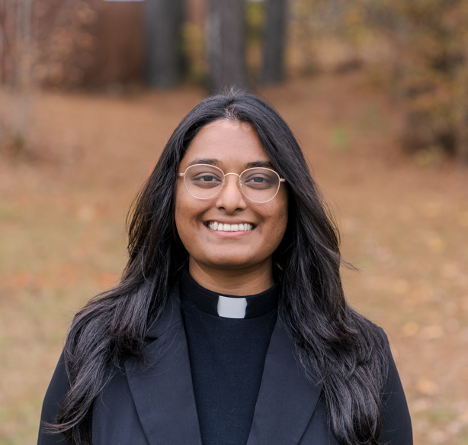
Sermon by Pr. Sharai Jacob on the Twenty-second Sunday after Pentecost, Reformation Sunday + Sunday, October 25, 2026
Have you ever known you were supposed to do something, but actually doing it was a whole lot harder than you expected? Someone explained it to you. You knew what you were supposed to do. But when it came time to do it yourself, something just wasn't clicking.
Sometimes I feel that way about today’s Gospel. We hear that we are supposed to love our neighbors, and yet, when someone cuts us off in traffic, or says something that makes us uncomfortable, suddenly loving our neighbor seems a whole lot harder than it did sitting in church.
In our Gospel this week, Jesus is asked which commandment is the greatest. He answers that we are to love God with all our heart, soul, and mind, and love your neighbor as yourself. On these two commandments, hang all the Law and the Prophets.
I wonder if there is more here than we sometimes notice. When Jesus tells us to love our neighbors as ourselves, I wonder how often we skip over those last two words: as yourself.
Sometimes we imagine that being a good Christian means putting everyone else first. We convince ourselves that caring for ourselves is selfish, or that we have to earn our rest by doing enough for everyone else. And our culture doesn't help with that. We live in a world that measures people by their productivity, and how successful they appear. We can begin to believe that our value depends on how useful we are. But Jesus doesn't say, “Love your neighbor instead of yourself.” He says, “Love your neighbor as yourself.”
Jesus reminds us that we are also people worthy of love and care. If God loves us, then our need for rest, friendship, and healing matters. When we learn to care for ourselves, we may find that we have more energy to care for others, too. We can listen with more patience and give without believing that we have to give everything away. Recognizing our limits doesn't mean we have failed at love. It just means we are human.
After Jesus answers the question about the greatest commandment, he asks a question of his own, “What do you think of the Messiah? Whose son is he?” The people answer that the Messiah is the son of David. Jesus then asks them about a passage in which David calls the Messiah “Lord.” If the Messiah is David's son, why does David call him Lord? No one can answer him.
Aside from the idea of Jesus as the Messiah and the Son of God, I wonder if Jesus is also inviting us to reconsider what we assume about authority and hierarchy. David was a great king, and yet the passage Jesus quotes presents David honoring someone who comes after him. The exchange unsettles the expectation that we can always understand a person's importance simply by looking at their place in a hierarchy.
Even today, our world pushes us to rank people. We pay attention to titles, wealth, education, and social standing. We can assume that the person with the most authority must have the most wisdom, or that the person who has accomplished the most deserves the most respect.
Assumptions like these can make it difficult to truly love our neighbors, especially when our assumptions are often unknowingly tinted by racism and classism. We inherit ideas about who is trustworthy, and whose ideas matter. Capitalism teaches us to measure people by their income, or perceived success. White supremacy teaches us to assign greater credibility, safety, or value to some people and not others based on their race.
These lessons don't always show up as obvious statements about what we believe - they often go unnoticed. They subtly sway our first impressions of people, which people we instinctively trust, or whose mistakes we are willing to forgive. Whose stories do we believe without a second thought? Who do we demand additional proof from? When we decide who someone is before we've taken the time to know them, we miss the gifts they bring into our communities - in Ubuntu we might say we lose a piece of who we are. Ubuntu is an African Philosophy that states “I am who I am because of who we all are together.”
Love invites us to take a closer look at our assumptions. Jesus' questions about the Messiah invite us to loosen our grip on the hierarchies we have come to accept. When we catch ourselves making assumptions, perhaps we can become curious about that judgment instead of immediately trusting it. We might discover that our neighbor has something to teach us, or that the story we had been telling ourselves was never the whole story.
But here’s the part where I struggle the most: when I see someone participating in an unjust system, or sharing hateful ideas - I’ll be honest, I struggle to love that neighbor! Thankfully, loving our neighbors doesn't mean ignoring harm or pretending that injustice doesn't exist. When our neighbors cause harm, love may look like speaking up against that. We are called to challenge systems and ideologies that keep people from being treated with dignity.
It can be a real challenge to do that from a place of love! We can’t always wait until we feel love in our hearts before we interact with our neighbors. Sometimes we have to choose to act with love before we feel it. Perhaps, over time, our hearts will begin to catch up.
Loving our neighbor doesn’t have to mean pretending we feel something we don't, or accepting harm in the name of being a good Christian. It means trusting that love is more than a feeling. It is also a way of being with one another, something we learn through practice. And when we fail, as we will, there is Grace for us all so we can try again.
This is good news for Reformation Sunday! Throughout its history, the church has had to examine its traditions and practices, recognizing that some have helped people experience God's grace while others have obscured it. The work of reformation asks us to remain open to the Holy Spirit's call to change.
That work begins with grace. We don't have to earn God's love by getting everything right. God loves us while we are learning, and that love gives us the freedom to acknowledge when we have been wrong and to grow.
Perhaps this is what it means to be a church that is always being reformed. We keep returning to the words of Jesus, allowing them to challenge the ways we treat ourselves and one another. We learn that love is not simply a feeling we hope to have someday. It is a practice that shapes our lives, our relationships, and our community.
We are not loved because we have perfected love. We are loved, and so we begin. Again and again, by the grace of God, we begin.
Amen.