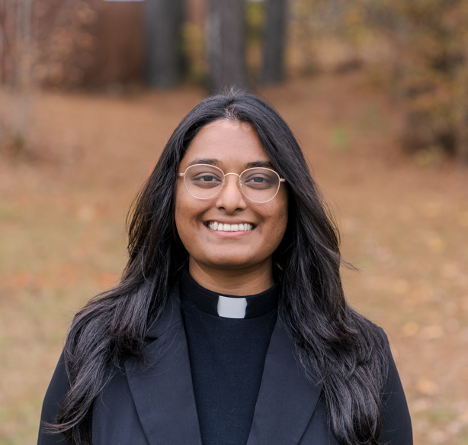
Sermon by Pr. Sharai Jacob on the Second Sunday of Advent + Sunday, November 15, 2026
This week’s gospel reading is one I’ve heard many times, the parable of the talents. A master gives his three servants a ridiculous amount of money. He gives his first servant 5 talents, the second gets 2 talents and the third gets one talent. Just one talent was worth 6000 denari. Servants were paid 1 denari per day of labor; it would have taken 16-20 years to earn one talent!
The first two servants take what they’re given and make more from it, they please their master. But, the third servant is afraid. He buries his one talent, and returns it to the master exactly as he received it. The master calls the third servant wicked and lazy, and throws him into the outer darkness, where there is weeping and gnashing of teeth.
I usually hear this parable taught to encourage people to live up to their potential, “God has given you gifts, use them!” Which is a good lesson to take away, we should absolutely use our gifts to share God’s love with the world. But as a parable, this reading can be interpreted in many ways! This interpretation assumes that the master in this parable represents God. If we take a closer look at the Master, we may find some new meaning in this story.
The third servant describes the master saying, “I knew that you were a harsh man, reaping where you did not sow and gathering where you did not scatter." He’s saying that this master takes what he hasn’t worked for. The master even confirms that this is true, “You knew, did you, that I reap where I did not sow and gather where I did not scatter?” His wealth depends on a system that keeps him rich, while the poor do all the work. I don’t think that my idea of who God is includes traits like, taking from the poor to give to the wealthy. So if the master is not God, then how is this story like the kingdom of God?
What if the kingdom of God is like the third servant? The servant who knows their master is participating in an unjust system, and refuses to play the game. The first two servants do as they’re told, and make their master even more wealthy. They are productive, good, and trustworthy. The third servant says that he was afraid. He must have known the consequences of disobeying his master, but he refused to give even more power to a Master who upholds a system of exploitation. He doesn't make the master richer. He doesn't cooperate. And the master calls him lazy and wicked. The things that make us good and faithful citizens of an unjust system are often the very things that make us unfaithful to the kingdom of God.
Sometimes, being a good citizen is exactly what we're called to be. We care for our neighbors. We participate in our communities. We work for the common good. But what happens when the systems we're asked to be loyal to are harming our neighbors? What happens when leaders lie, when immigrants are treated as threats instead of human beings, when the poor are exploited by the powerful, when war is more profitable than healthcare? What does faithfulness look like then? at does faithfulness look like the
It looks like good trouble. Protecting someone who is being targeted. Sharing resources instead of hoarding them. Showing up when it would be easier to stay home. Refusing to let fear determine who our neighbors are. Telling the truth when believing the lie would be more comfortable. In other words, maybe sometimes faithfulness looks like burying the master's money.
Another thing to pay attention to is what happens to this servant. He is thrown into the outer darkness, where there is weeping and gnashing of teeth. Surely that is not what Jesus is calling us to, right? Except if we look at Jesus’ story, he refused to comply with injustice and was crucified for it. Is Jesus calling us to risk everything, our lives, for the sake of the gospel? I think, before we start quitting our jobs and risking it all, we should read a little bit further.
Immediately following this parable, Jesus goes on to directly describe what will happen, “when the Son of Man comes in his glory…” The nations are gathered before him. And the king separates people, not according to their wealth, their productivity, their political loyalty, or their ability to follow orders. Instead, the measure is: "I was hungry and you gave me food. I was thirsty and you gave me something to drink. I was a stranger and you welcomed me…” This is not a call to destroy ourselves for the good of others. This is actually still a call to use what we were given! To use our wealth, power, and privilege to change unjust systems, to feed the hungry, to heal the sick, to welcome the stranger.
Then Jesus says, “Just as you did it to one of the least of these, you did it to me.” Jesus identifies himself with the hungry, the thirsty, the stranger, the imprisoned, and the vulnerable. Which makes me wonder: What if Jesus is the third servant?
Jesus refuses to cooperate with the power structures of his day. He challenges religious authorities. He eats with people rejected by society. He welcomes those pushed to the margins. He speaks truth to empire. He refuses the logic that says power, wealth, and domination are signs of God's blessing. And the empire kills him for it.
But the empire doesn’t get the last word. What if the resurrection is God's great act of noncooperation with death? God refuses to let systems of violence and domination have the final say. And that, I think, is Good News.
We are not called to be productive servants of an unjust master.
We are not called to confuse obedience with faithfulness.
We are called to participate in the kindom of God. Jesus describes: a kindom where hungry people are fed, strangers are welcomed, prisoners are remembered, and the vulnerable are treated as beloved children of God.
Yes, sometimes that will get us into trouble. So maybe the question isn't whether we've made the most of what we've been given. Maybe the question is: What are we being asked to participate in, and what are we being asked to refuse? Whose power and wealth are we increasing? Whose lives are we protecting?
And when the kingdom of God comes into view, will we be found standing with the powerful, or with the hungry, the stranger, and the vulnerable whom Jesus calls his own?
May we have the courage to refuse what is unjust, and to make some good trouble for the sake of the kingdom.