Don’t Miss It!
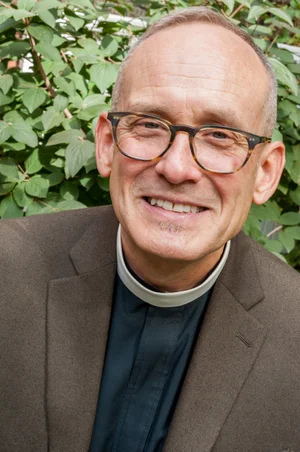
Sermon by Pr. Craig Mueller on the Seventh Sunday after Pentecost + Sunday, July 12, 2026
This past week I was in a bit of a funk because inspiration for this sermon was not coming. So, I decided to walk to the lake. Nature can provide inspiration and can be one of our best spiritual guides.
I love being able to walk along the lake. However, sometimes we don’t notice what is right in front of our eyes. Because we have seen it so many times already. There are times when I notice the color of the water. The calmness or the strong waves. Or the buds in spring or the colors in autumn. But at other times I am in my own little world or absorbed in conversation. And I miss what is there. I don’t see it.
As I was sitting by the lake, something caught my eye. All the plants growing out of the concrete stepped slabs, called revetments. It isn’t a garden. There’s not soil, to speak of. I would expect a few weeds here are there. But no! Some of the growth is four feet tall. There are trees and bushes growing out of the slabs that are taller than I am and six feet wide. There are beautiful flowering weeds and I saw pollinators—butterflies and bumble bees darting in and out among them. It all seemed too beautiful and too extensive to be weeds.
The entire scene caught me by surprise. And raised questions. Surely humans didn’t scatter seeds along the slabs and in the cracks.
I could have easily missed it. Maybe it was my own parable. The kingdom of God is like beautiful weeds and bushes that grow and flourish out of cracks and crevices in ugly retaining walls. And attract pollinators.
When we are distracted or overwhelmed. When we are on autopilot and think we have everything figured out, Jesus uses parables to open our eyes and ears to recognize something we might miss: the kingdom of God breaking in around us.
Once upon a time there was a young pastor in a rural congregation. He studied the parable of the sower long and hard. He translated the original Greek and read many commentaries. In his sermon he shared all his learnings and waxed eloquently about seeds and soil. Many parishioners gave the obligatory handshake and “nice sermon, pastor” on their way out of church. But one scruffy farmer said hesitantly, “Son, it’s a lot simpler than that. Come on down to the fields sometime. We will teach you something about planting.”
Parables help us to see something easy to miss. They often shatter our well-worn ways of thinking and make us vulnerable to God. In fact, we don’t interpret parables. They interpret us. And if they make you wonder or question or even squirm, they are doing their work on you.
In the parable of the sower and the seeds and the soil, the return rate isn’t so great. It’s three to one. The seeds that fall on the path, the rocky ground and among thorns don’t make it. Not like the weeds growing out of the concrete slabs by the lake, that’s for sure. The sower scatters the seeds indiscriminately, for many a sign of God’s extravagant grace. But there’s not always receptivity. How is that sometimes true for us? What kind of soil are we? How might the parable help us to reflect on Holy Trinity’s mission or even on this time of transition?
There are always distractions and lures and concerns that inhibit our receptiveness to the things of God. For many of us the device in our hands often keeps us from noticing the trees and the birds, the faces of those around us, the needs of others.
Social media has brought us the concept of FOMO: the Fear of Missing Out. Others might be having fun or great experiences while you are not. But I’d like to propose FOMI: Fear of Missing It. Missing the meaning. Missing the purpose. Missing God in the things of everyday life.
I’ve been reading Superbloom: How Technologies of Connection Tear Us Apart by Nicholas Carr. In our factitious political climate, social media is often blamed. Yet Carr argues that we are missing the motivation of users and the deep-seated tendencies in human nature. Several centuries ago, James Madison wrote that the latent causes of faction in religion and government, among other things, are sown in human nature. This leads to mutual animosity. We are more apt to oppress one another than work toward the common good. For Carr it’s not just social media, but a crowded virtual public square with no checks on humanity’s darker side.
St. Paul warns against not setting our minds on the things of the flesh. We hear “flesh” and think Paul is being anti-body and we cringe. After all, the Word became flesh and bodies are good! One commentator helps by interpreting Paul’s “in the flesh” as being part of a weakened will within humanity to the right thing.
To live according to the Spirit is life and peace. Despite our lack of receptivity or the low return rate, the Divine Sower keeps on sowing seeds. Until there is a fruitful harvest.
Last week we watched the musical Suffs in a PBS filmed version available online. And we will be seeing Suffs in person a week from today as it is in Chicago right now! Suffs is about the women’s suffrage movement and reminds us that much of what we strive for takes time, comes with setbacks, and is never fully achievable. Though a lot of hard work granted women the right to vote in 1920, they were only able to obtain the vote for white women.
As one song states, “the work is never over…the path will be twisted, and risky, and slow, but keep marching.” The song reminds us: “your ancestors are all the proof you need that progress is possible, not guaranteed. It will only be made if we keep marching.”
We could add: some seeds will not produce fruit— but keep sowing. Keep marching. Joyfully. Don’t miss it! We join Isaiah in celebrating what God has done in the past even as we strain toward what is yet to be. Even the mountains will burst into song. And the trees shall clap their hands. Instead of the thorn shall come up a beautiful cypress. And who knows what will grow from the cracks and crevices and between the concrete slabs. Christ is the seed that brings new life at this table. And leads us to bear fruit in the world.
Don’t miss it. Don’t miss what poet E.E. Cummings proclaims:
i thank You God for most this amazing
day: for the leaping greenly spirits of trees
and a blue true dream of sky; and for everything
which is natural which is infinite which is yes
He ends the poem:
(now the ears of my ears awake and
now the eyes of my eyes are opened)
Amen.
SOURCES
Nicholas Carr, Superbloom: How Technologies of Connection Tear Us Apart.
Diane Jacobson, New Proclamation commentary for Lectionary 15a
Thomas Long, Proclaiming the Parables: Preaching and Teaching the Kingdom of God
Barbara Reid, Parables for Preachers, Year A