

HTBLOG

At Six Months: Overwhelmed
“The six-month mark in any sustained crisis is always difficult,” writes Dr. Aisha Ahmad, political science professor and Director of the Islam and Global Initiative at the University of Toronto.
“The six-month mark in any sustained crisis is always difficult,” writes Dr. Aisha Ahmad, political science professor and Director of the Islam and Global Initiative at the University of Toronto.
Ahmad goes on to say that it is completely normal at six months for us to struggle or slump, to want to “get away” or “make it stop.” We’ve learned a new normal: new ways to eat outside at restaurants, host meetings, teach and learn, even have fun. But the autumnal equinox brings shorter and cooler days. Our patience is running thin even as we realize that more innovation, creativity, and patience is being called from us.
Many of us feel irritable and exhausted. Overwhelmed.
As a faith community we turn to our spiritual ancestors for inspiration. One Lutheran I would hold up is Martin Rinkart. During the Thirty Years War (1618-1648) he was pastor in Eilenburg, Saxony (Eastern Germany). The walled city was a refuge from fugitives suffering from epidemic and famine.
As other clergy fled the town, Pastor Rinkart sometimes officiated as many as forty or fifty persons per day—some 4,480 in all! During 1637—the worst year—his wife died as well. Refugees had to be buried in trenches without services.
Amid great risk and overwhelming conditions, Rinkart continued to minister to the people in his city, giving away nearly everything he owned to the poor and needy, barely able to clothe and feed his own children.
During hardships beyond imagining, Pastor Rinkart wrote a table prayer for his family. In all things he taught his children to give thanks for the “countless gifts of love” provided by our bounteous God.
May this beloved Lutheran hymn inspire us with hope, clinging to the grace of God that “frees of all ills” as we live into an unknown future.
Now thank we all our God, with hearts and hands and voices,
who wondrous things has done, in whom this world rejoices;
who from our mother’s arms, has blessed us on our way
with countless gifts of love, and still is our today.
O may this bounteous God through all our life be near us,
with every joyful hearts and blessed peace to cheer us;
and keep us all in grace, and guide us when perplexed,
and free us from all ills in this world and the next.

At home... (Pr. Craig Mueller)
There are many losses that I grieve in not being together in person for the multisensory liturgy that we treasure. At the same time, these next months and years will be an opportunity for us to see our homes as a locus of ritual and spirituality. I envy Jews for the rich ritual experience centered in their homes: Passover seders, lighting Chanukah candles, and of course, the weekly Shabbat meal that ushers in the Sabbath. Throughout the day faithful Jews recite blessings, connecting faith and their everyday lives.

Several weeks into the pandemic The New York Times suspended the travel and sports sections of their Sunday edition. Instead, a new section, At Home, includes simple recipes, ideas for family games and art projects, and creative suggestions for making the most of quarantine.
We are into the twenty-second week of this weird reality of staying home and experiencing much of life through our computers: video conferencing with work colleagues and families; classes, advocacy and interest groups; and yes, even church. Thanks to all who filled out Holy Trinity’s survey regarding online worship, communion, and returning to our building. We have had a great response so far, but we would like as many as possible to participate—this coming Sunday is the deadline.
The more we learn about the coronavirus and vaccines, the more we sense we will not be returning soon to the lives we knew only a year ago. It appears that most churches, schools, and other organizations will be moving to a hybrid approach in the future: a combination of in-person and online gatherings.
There are many losses that I grieve in not being together in person for the multisensory liturgy that we treasure. At the same time, these next months and years will be an opportunity for us to see our homes as a locus of ritual and spirituality. I envy Jews for the rich ritual experience centered in their homes: Passover seders, lighting Chanukah candles, and of course, the weekly Shabbat meal that ushers in the Sabbath. Throughout the day faithful Jews recite blessings, connecting faith and their everyday lives.
In some Christian circles the home is sometimes called the “domestic church.” Though we may gather on Sunday as the assembly of God’s people, it is in the home where most of the daily rhythms of life occur: preparing meals and eating, cleaning and working, conversing and sharing hospitality, resting and sleeping.
Yet to use the word “home” does not suggest simply one picture. It may be a large house, an apartment, a single room, or a bed in a care center. It can be a retirement home or a convent. It may include children with one or more parents. It may be for one person, a group of people living together, or roommates. In all these settings the ordinary patterns of daily life hold the opportunity for celebrating God’s gracious presence.
I hope that our congregation, denomination, and publishing house develop new materials to help us pray and observe rituals in our home. Someone suggested to me that we should not only bless backpacks, but we should also bless masks and computers, for example.
A simple way to begin is meal blessing and prayers, if you are not already doing so. Here is a starter kit. Mix and match among these options:
Make the sign of the cross.
Be mindful of the food before you. Pause, look at the food for a moment of silence before you eat.
Come Lord Jesus, be our guest. Let these gifts to us be blessed. Blessed be God who is our bread. May all the world be clothed and fed.
Bless us, O Lord, and these your gifts which we are about to receive from your bounty. Through Christ our Lord.
O give thanks to the Lord whose mercy endures forever.
The eyes of all wait upon you, O Lord, and you give them their food in due season. You open wide your hand and satisfy the desire of every living thing.
May all be fed. May all be healed. May all be loved.
For what we are about to receive, may the Lord make us truly thankful.
O God, bless this food we are about to receive. Give bread to those who hunger, and hunger for justice to those of us who have bread. (Nicaraguan)
Families: check out Peanut Butter and Jelly Prayers (Morehouse, 2016) by our own Julie Sevig.
Though not together in person on Sundays, may you experience blessings of grace these days even as you bless God in times of both joy and sorrow, plenty and want.

Online Liturgy with Communion + Sunday, August 2 + 9:30am
How shall I prepare for communion in my home?
Set a table as if you were hosting a special guest, which in this case is the Risen Christ. Put out a tablecloth or piece of fabric. Choose a small plate and a wine glass or cup. Light a candle. Place other sacred items on the table such as a bible, icon, or flowers.
BREAD. One option is to purchase a small baguette or dinner roll. Or consider baking bread, which is a holy experience in and of itself. Though any recipe for bread is fine (even without yeast), you may want to make the Holy Trinity communion bread recipe, perhaps making half of the recipe. You could freeze some of the loaves for future services.
WINE/JUICE. You may use a bottle of wine and drink the rest of it over the next few days. Some wineries (such as Sutter Home) make small 187 ml bottles. Grape juice (or another kind of juice) is fine, too.
Information on communion at Holy Trinity during quarantine may be found here.
How shall I prepare for communion in my home?
Set a table as if you were hosting a special guest, which in this case is the Risen Christ. Put out a tablecloth or piece of fabric. Choose a small plate and a wine glass or cup. Light a candle. Place other sacred items on the table such as a bible, icon, or flowers.
BREAD. One option is to purchase a small baguette or dinner roll. Or consider baking bread, which is a holy experience in and of itself. Though any recipe for bread is fine (even without yeast), you may want to make the Holy Trinity communion bread recipe, perhaps making half of the recipe. You could freeze some of the loaves for future services.
WINE/JUICE. You may use a bottle of wine and drink the rest of it over the next few days. Some wineries (such as Sutter Home) make small 187 ml bottles. Grape juice (or another kind of juice) is fine, too.
How will communion online work?
Gathered as a live community via Zoom, during the prayer of thanksgiving (in gallery view), the assembly will hold up their bread and wine as we pray for the Holy Spirit to come upon us and the meal we share. At the time of communion, those gathered with others will say to one another, “the body of Christ given for you,” and “the blood of Christ shed for you.” If you live alone, the presiding minister will say these words to you as you eat and drink. Though we are gathered as a community, Christ’s presence and promise of forgiveness and grace is for each individual person.
What if I choose not to commune online?
As we do in the church building, a blessing will be spoken for all those not communing. Christ is truly present in the Word of life, and in the Spirit within us.
When will communion be offered at HTLakeview or HTLoop?
In June we offered communion in HTLakeview’s garden and had only five express interest. We anticipate there will be opportunities for small groups to receive communion in person, at some point. Please speak with one of the pastors to discuss communion brought to your home, if that is advisable.
What should I do with the bread or wine not consumed in the liturgy?
As the ELCA sacramental statement recommends and as we practice at Holy Trinity, the remaining bread and wine are consumed following the service (or at meals throughout the day). It is also possible to pour remaining wine on the ground and to place bread there for the birds and as a gift for creation. In all cases, “the bread and wine of Communion are handled with care and reverence, out of a sense of the value both of what has been set apart by the Word as a bearer of the presence of Christ and of God's good creation.” (Use of the Means of Grace, #47)
How is communion related to Holy Trinity’s mission?
The eucharist is not only for spiritual comfort and to strengthen our faith. We become what we eat. We are the body of Christ for a suffering world. In a post-communion prayer that we often use: O God, we give you thanks that you have set before us this feast, the body and blood of your Son. By your Spirit strengthen us to serve all in need and give ourselves away as bread for the hungry, through Christ our Lord.
Is online communion the new norm for Holy Trinity?
Because these are extraordinary times, Holy Trinity’s staff recommends this practice for pastoral reasons. Communion online (as part of a live Zoom communal liturgy) will be offered monthly for the time being.

Urgent Need from the Lakeview Pantry
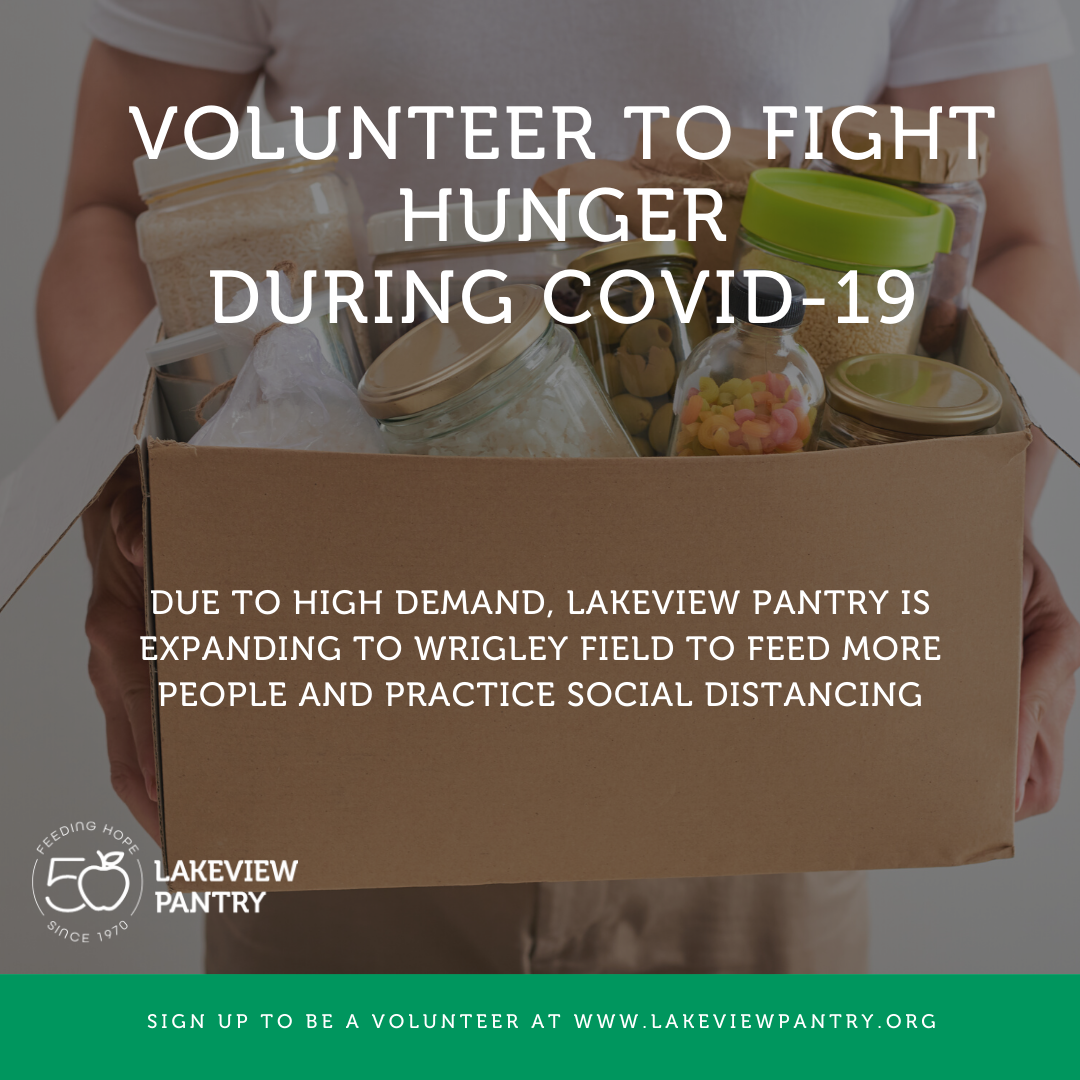
Volunteers Needed: Since the COVID-19 outbreak hit the city, visitors to Lakeview Pantry, Chicago’s largest food pantry, including all of the Pantry’s food programs (physical sites, Online Market and Home Delivery) have increased by over 80%. To help keep up with demand, and offer a safe space for volunteers to help sort and pack food, the Pantry will be setting up and managing a temporary satellite food distribution center on the main concourse at Wrigley Field. They are in need of more volunteers to meet demand, visit lakeviewpantry.org/volunteer/ to learn more and sign up. Can’t volunteer? Consider making a donation to help those in need.
Volunteers Needed: Since the COVID-19 outbreak hit the city, visitors to Lakeview Pantry, Chicago’s largest food pantry, including all of the Pantry’s food programs (physical sites, Online Market and Home Delivery) have increased by over 80%. To help keep up with demand, and offer a safe space for volunteers to help sort and pack food, the Pantry will be setting up and managing a temporary satellite food distribution center on the main concourse at Wrigley Field. They are in need of more volunteers to meet demand, visit lakeviewpantry.org/volunteer/ to learn more and sign up. Can’t volunteer? Consider making a donation to help those in need.

Church and COVID-19
During these days of COVID-19 (coronavirus) concerns, there are several best practices that we can undertake to protect each other, especially the most vulnerable among us, from illness as much as possible:
Come to church as long as you are free of symptoms and have not been in conscious contact with persons and places of known exposure to the virus. If you are sick, please stay home from worship. This is a practice of “thinking beyond ourselves” and caring for all members of our community, particularly the most vulnerable. More and more we are offering livestreaming of services and sermons and service recordings are posted on Mondays.
Wash your hands often. Soap and water are your best defense. Wash your hands long enough to say the Lord’s Prayer. Hand sanitizer is always available for your use before receiving communion. Your pastors will wash their hands immediately before communion and those who administer the wine will use hand sanitizer before receiving the cup.
Consider a no-touch sharing of the peace. A simple bow is a wonderful no-touch way to recognize the presence of God in each other at the peace. It is always a best practice to ask before touching one another during the peace at any time (read more about consent culture in the church here).
Drinking from the common cup is the most sanitary way to receive the wine at communion. Intinction (dipping the bread in the wine) is discouraged. AT HTLOOP, because we don’t have separate cups for common cup and intinction, we ask you to REFRAIN FROM INTICTION and either drink from the common cup or receive only the bread. Receiving the bread or gluten-free wafer alone is a full and complete reception of communion.