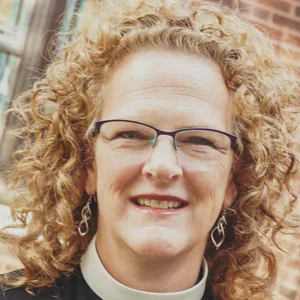
Sermon by Pr. Michelle Seving on All Saints Sunday + Sunday, November 1, 2026
Oftentimes in my work as a hospital chaplain, when I’m with someone whose loved one is dying or has recently died, I invite them to take a deep breath. To sigh. Sometimes I take that breath with them. (Deep sigh.) And then I paraphrase these words from Romans: “When we do not know how or what to pray, the Spirit intercedes for us with sighs too deep for words.”
Our sighs are prayers too. Sometimes they are the only prayers we have.
Sighing and crying seem to go hand in hand. When we’re anxious about the future or replaying something from the past. When we’ve lost someone we love, a relationship, a job, a hope we had for our lives. We breathe out what we cannot explain. Tears come when words won’t. And the Spirit receives it all.
On All Saints Sunday, we make room for that here, together. We name people we love and miss. We remember their voices, their particular quirks, the things they did that made us laugh—or drove us a little crazy. We give thanks for having known them. And we acknowledge how much we wish they were still here.
Some losses are fresh, others have been with us for years. But grief doesn’t pay much attention to the calendar. A familiar hymn, someone’s handwriting, the urge to call someone who can no longer answer—and there it is again. The sigh. The tears.
Into this gathering, Jesus speaks: “Blessed are those who mourn, for they will be comforted.” I wonder what it was like to hear those words for the first time. To sit among the crowd carrying your own sorrow, perhaps feeling that God had forgotten you, and hear Jesus call you blessed.
Jesus does not say, “Blessed are those who have gotten over it.” He doesn’t ask anyone to stop crying before he comes close. He looks at people whose hearts are broken and declares that God’s promise belongs to them. God is drawing near, right there in the midst of their grief.
The beatitudes reveal a world ordered differently from the one we know. The meek inherit the earth. The merciful receive mercy. Those who hunger and thirst for righteousness will be filled. People with little power or protection hear Jesus promise them a place in God’s future.
We know saints who have lived these promises; people whose names and stories will never appear on any official church list of recognized saints:
Someone who tended to a dying spouse
Someone who kept showing up with food for a hungry neighbor who lives under the viaduct
Someone who showed compassion to a person others had pushed aside
Someone who could sit with us while we cried.
There is a concept from Celtic spirituality that I find helpful today: “thin places.” Places or moments when the distance between heaven and earth seems especially small. When we sense something beyond what we can see or explain.
When my niece Kirsten’s mother was dying, Kirsten sent Julie and me a text message. She described how she and her sister got up through the night to tend to my sister-in-law, Else. They would find their way to their mother by cellphone flashlight to prepare medications, hold her hand, and kiss her cheek. “This care felt ancient,” she said, “I could easily imagine the two of us in long nightgowns, holding a lantern, and doing much the same as others have done for generations.”
Then she told us about singing one of her mother's favorite hymns. Else opened her eyes and looked beyond her, a hint of a smile on her face. To Kirsten, it seemed as though her mother was being visited by dear friends. Kirsten was in awe.
Julie responded with an image that has stayed with me: Elsa surrounded by loved ones on both sides–those here tenderly holding her and letting her go and those from beyond welcoming her home.
We couldn’t know exactly what her dying mother was experiencing. But there was something holy in that room, in the singing and the watching, the holding on and letting go. And even through a text message, we could feel it–a thin place. It brought us to tears.
All Saints Sunday is a thin place too. We speak familiar names. We light candles. We hear that those who have died belong to God, and that we belong to God too. In our sighing and crying, we are held together by a love that even death cannot undo.
And into this tender space, the words in Revelation offer a promise: “God will wipe away every tear from their eyes.” To wipe someone’s tears, you have to come close. Close enough to see their face. Close enough to touch their cheek. The God who holds all the saints comes close enough to tend to each person’s sorrow.
Today we remember those whose names are precious to us, as well as those whose deaths received little attention. People who died without a home or someone beside them. The pregnancies that were lost and the children who are longed for. People separated from family or rejected because of who they are. We cannot name everyone, but God knows each one.
And God’s promised future shapes how we live now. We feed people who are hungry. We offer shelter. We advocate for those who are threatened by ICE, genocide and war. We sit with those who mourn. Through these acts of mercy, our neighbors may experience the comfort Jesus promises and gives.
During the liturgy today we have several ways to honor/remember those closest to us who have died–whether it’s this year or many years ago.
During communion you may light a candle at one of the tables in memory of someone dear to you.
You may also write their name in the book of remembrance at the back of the church.
And during the prayers, as the bell rings, you are encouraged to speak names aloud, filling this space with the names and memories of those we love who have gone before us.
A former member, Louise Goos, used to say she could imagine her departed family members gathered around the altar at communion with her in this sacred meal. I love that image. As we commune, we gather with all the saints, joining the faithful of every time and place.
We come to this table carrying both grief and gratitude. So take a breath. A deep one. Bring your sighs, your tears, your names, your memories. There is room for all of them here.
Blessed are you who mourn. The God who promises to wipe away every tear is already drawing close.