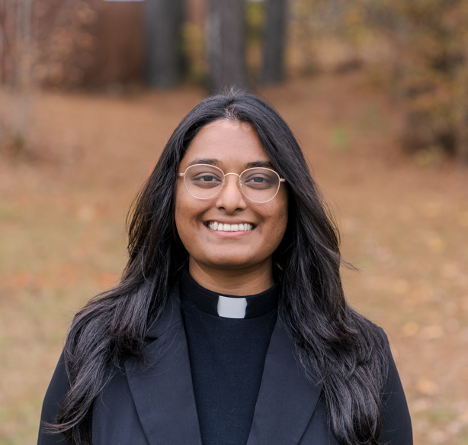
Sermon by Pr. Sharai Jacob on the Third Sunday of Advent + Sunday, November 21, 2026
Most of us know the story of A Christmas Carol by Charles Dickens. It's the story of Ebenezer Scrooge, a man who has spent his life accumulating wealth while becoming increasingly disconnected from the people around him. He has little interest in the struggles of others, and he sees their needs as someone else's problem. Until one night, when he is visited by three ghosts. They show him the past, the present, and the future. And what they reveal is terrifying! He sees the relationships he has neglected, the suffering he has ignored, and the lonely, empty future that awaits him if nothing changes.
But here's what I love about the story: The ghosts don't come to condemn Scrooge. There is still time, he can change his future by changing his present. And that, I think, is a helpful way to approach today's Gospel.
In Matthew 25, Jesus gives us a dramatic warning, a vision of the future. The Son of Man comes in glory, gathers all the nations, and separates people from one another as a shepherd separates sheep from goats. There is judgment, consequences, and the language Jesus uses is unsettling.
But what is particularly interesting is what determines who are sheep and who are goats. It’s not about church attendance, personal purity, or how strongly people professed their faith. It’s all about food, water, and welcome. Whether people noticed one another's suffering and responded to it.
And then comes the startling revelation: "Just as you did it to one of the least of these, you did it to me."
I wonder if we have really taken in what Jesus is saying here. Because this isn't an undercover boss situation. Jesus isn't secretly testing people, disguising himself as someone in need to see who passes the test. He's telling us something much more profound than that.
Jesus is telling us that our lives are bound up with one another. That we cannot separate our relationship with God from our relationships with each other. I’ve mentioned in previous sermons, the South African philosophy of Ubuntu which can be translated: "I am who I am because of who we all are together." Our humanity is not something we possess entirely on our own. We become who we are through our relationships with one another. Our identities, our well-being, and our ability to flourish are interconnected.
Another expression of this philosophy says, "I am another you." If I love you, I am loving myself. If I diminish you, I diminish myself. If I deny your humanity, I participate in the denial of my own.
And there is something important about the mutuality of this idea. Ubuntu isn't simply about caring for other people. It is about belonging to a community in which we are both the carers and the cared for.
We cannot fully participate in community if we are only ever the ones giving. We must also be willing to receive. Otherwise, we haven't created a relationship of mutual belonging. We've created a hierarchy.
And I think in this text, Jesus is including himself in the community of Ubuntu.
Jesus isn't standing outside the community, asking us to care for everyone else. Jesus is part of the community itself. When one of us is hungry, when one of us is lonely, when one of us is excluded, something happens to all of us. So, when one of us is harmed, Jesus is part of the whole community that is harmed because of it. Jesus isn't separate from our humanity. Jesus is telling us that our humanity is shared with his own.
That brings us to the more difficult part of this passage.
The language of eternal punishment can be frightening. And depending on our religious backgrounds, we may have inherited some very vivid images of what that means. Images of pitchforks, demons, and people being tortured often come to mind. But much of the popular imagination of hell was shaped by works of literature and art, like Dante's Inferno, rather than being drawn directly from Scripture.
So what do we do with Jesus' words about eternal punishment? I don't think we need to dismiss the seriousness of what Jesus is saying. But perhaps we can spend some time thinking about what eternal punishment actually means.
What if eternal punishment isn't some mysterious, terrifying possibility waiting for us after death? What if we already know something about what that punishment feels like?
We experience it whenever we become so focused on our own comfort, or our own sense of being right that we stop noticing the people around us. Or sit beside someone in the pews, but fail to recognize their loneliness, grief, or need to be welcomed. Whenever we create divisions between ourselves and others. That separation from loving community, that emptiness, that is the eternal punishment. And it isn't something God wants for us.
As Lutherans, we believe that all are saved by grace alone. Not by successfully separating ourselves into the sheep category. God's love is not a reward for good behavior. It is a gift freely given. And that gift frees us all to experience eternal life in our daily lives, too.
Eternal life isn't just a reward we receive someday, after we die. It is life lived in relationship with God and with one another. It is the experience of belonging, of being known and loved, of giving and receiving care. We catch glimpses of it whenever someone makes room for us. Whenever we are honest about needing help. Whenever we show up for one another in grief, in joy, and in the ordinary struggles of being human. These are moments when we create a little more of the kingdom of God.
Perhaps this gives us a different way to think about the sheep and the goats. I don't think any of us is permanently one or the other. We are all sheep, and we are all goats. We are all Saints and Sinners.
And that means this Gospel isn't an invitation to divide the world into the good people and the bad people. It is an invitation to pay attention to the ways we are living together, and to ask what we might do differently.
What would it look like to build a community where everyone has the opportunity to give care and receive care? What would it look like to recognize that when one person is excluded, we are all diminished? And when one person is welcomed, we all become more whole?
So perhaps the question this Gospel leaves us with isn't simply, "Am I a sheep or a goat?" Perhaps the question is: "What kind of life are we creating together?"
Both eternal life and eternal punishment are not just waiting for us at the end of days. We experience them in the ways we treat one another every day. We create them for our community in the ways we show up or cause harm.
And the good news is that we don't have to wait until some distant future to choose differently. By the Grace of God we are freed to repair relationships, and make room. To learn to receive as well as we give. To recognize Christ in one another, not as someone outside our community who needs rescuing, but as one who belongs to this community just as we do.
God's grace meets us wherever we are in this story. And because of that, it isn't too late.
Amen.