What am I not seeing?
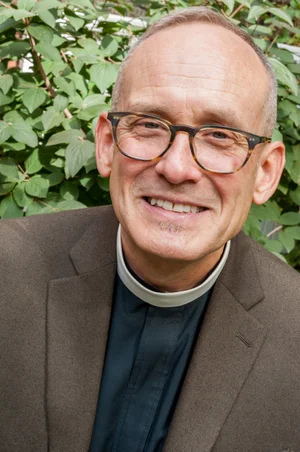
Sermon by Pr. Craig Mueller on the Fourth Sunday in Lent + Sunday, March 15, 2026
I’ve lost count of how many pairs of glasses I have worn throughout my life. What about you? How many of you have worn glasses or contact lenses at one time or another? Most of us have probably been to an optometrist. How many of us have been to an ophthalmologist? These doctors diagnose and manage more complex eye diseases.
Four or five years ago I was sent to an ophthalmologist with my optometrist’s observation I may have early symptoms of glaucoma. While the diagnosis is not certain even now, I have two different types of eye drops to help manage any onset of glaucoma and the risk of blindness.
There is a particular eye test that everyone hates. It’s a field of vision test. Anyone familiar with it? Looking straight ahead you stare into a bowl-shaped machine. Then you click every time you see a white blinking light. Simple, quick, painless … and nerve racking! I hate it.
And though my results are still quite good, there is a very small section in my field of vision that I am not seeing.
What are we not seeing? That’s the question for us as we consider today’s gospel that is fascinating and illuminating, troubling and ironic.
In the story, the sighted folks are the ones that don’t see. They are certain and that is the problem. They are certain that the man born blind from birth must have sinned, or at least his parents must have. They are certain he must be an imposter or is lying. They are certain that Jesus must not be of God because he performs signs on the Sabbath. And they are certain that they are seeing things as they are.
Their field of vision is limited. And that leads to Jesus’ enigmatic words to the sighted folks then and to us today. “I came into this world for judgment, so that those who do not see may see and those who do see may become blind.”
I don’t even know what to make of this.
First, this is a story of insiders and outsiders. Near the end of the first century followers of Jesus were being expelled from the Jewish community. It was a painful time. In John’s gospel believing in Jesus always brings division and crisis. He came to his own and his own did not receive him, we hear at the beginning of the gospel.
The poet Yehuda Amichai puts it like this: From the place we are right / Flowers will never grow / In the spring. In other words, it is smugness and certainly that can cloud our vision—like cataracts—from the truth of who our neighbor is and who we are as children of God.
Virtually no one in the story—not even the man’s parents— can rejoice with the man when he receives his sight. It may seem like this is a story about restoring a blind man’s sight. That’s what the religious authorities focus on. But there is more. Jesus makes mud with spittle and dirt, recalling humans created from the earth. Then tells the man to wash in the pool of Siloam which means “Sent.” Water, anointing, and commissioning. Sounds like baptism.
It makes me wonder what we are not seeing. For one thing, according to current neuroscience and psychology, 95% of our brain activity, decisions, emotions and behaviors are driven by our unconscious mind. In other words, there is a vast mysterious field of vision that we are often not seeing.
Often, we are like Samuel in the first reading, looking only on the outward appearances of others. And not seeing with the heart, as God does.
Before we judge too harshly those in the gospel with spiritual short sightedness, everyone has predetermined lens, the assumptions we make about how the world is. One neurobiologist writes that because we take in an overwhelming amount of visual information, we make snap judgements and random guesses about reality.
There is a trap in the gospel. Our natural response is to point the finger at others like all the characters in the story did. What does it take to let go of blame and recrimination? And to interpret life through the lens of divine love, healing, and reconciliation?
Helen Keller once said, “the saddest thing in the world is people who can see but have no vision.”
In Nazi Germany many Christians were not seeing what was occurring all around them. Instead, what was clear was loyalty to one leader. Belonging and purpose met through nostalgia for a former era. An inordinate sense of power. Political opponents were undermined. The scapegoating of others made killing seem cavalier. After the war the German church confessed its guilt and complicity. In the Stuttgart Declaration they accused themselves for not praying more faithfully, believing more joyously, loving more ardently.
This past week our Lenten book put forward the theme “accepting what you do not choose.” We read the words of Dietrich Bonhoeffer written from his prison cell in 1943: “No person is responsible for all the world’s injustice and suffering. Still, we must take part in Christ’s greatness of heart, in the responsible actions that in freedom lay hold of the hour.” As Bishop Budde added, “as much as we might want to walk away, this is our time.” We may not choose these circumstances, but we choose how we will respond.
For the early church—and for us—today’s gospel is about baptism and baptismal vocation. At the Easter Vigil we will follow a large candle into the dark church and chant, “the light of Christ.” We are anointed not with mud and spit as in the gospel, but with oil. One image for baptism is enlightenment. First, we admit that we are having problems seeing, spiritually, that is. You go to an optometrist for your regular eye check-ups. In the liturgy we confess our sin—the blind spots that keep us from seeing truth of who we are, and seeing others as they are, created in the image of God. Baptism calls us to more than sight only, but the deeper reality of insight.
When your field of vision is limited, there is always more than meets the eye. By amazing grace, we join in singing: I was blind, but now I see. Jesus, the light of the world, opens our eyes.
Learning how to see spiritually will take more than glasses and contacts. And here’s the prescription: community. A weekly gathering around word and meal. And drops and drops of grace. Amen.
SOURCES
Hannah Reichel, For A Time Such as This: An Emergency Devotional.
Mariann Edgar Budde, How We Learn to Be Brave: Decisive Moments in Life and Faith
Now I See: Salt Commentary for Lent 4.